Best AI Tools for In-Store Customer Behavior Analysis: Your 2026 Guide
You know exactly how many people clicked your last Instagram ad. You can trace them through your website, into a cart, and out the other side. Your flagship store last Tuesday at 2 p.m.? That's the black box — and the best AI tools for in-store customer behavior analysis are built to crack it open.
The market has consolidated around five core technology categories:
- Computer vision analytics — camera-based systems that track movement, dwell time, and product interaction without identifying individuals
- Sensor-based tracking — Wi-Fi, Bluetooth beacons, and ceiling-mounted sensors mapping foot traffic flow
- Predictive behavior engines — machine learning models that forecast demand, churn risk, and segment-level purchasing intent
- Sentiment analysis platforms — ML models processing in-store signals to gauge emotional engagement (some achieving 94.5% accuracy)
- Integrated retail intelligence suites — platforms combining POS, CRM, weather data, and staffing inputs into a single operational view
When evaluating platforms, three criteria matter more than feature lists. First, measurement accuracy — the current benchmark sits at 89% accuracy for predicting short-term demand swings through real-time behavior analysis. Second, privacy compliance architecture — not a checkbox, but the actual engineering of how data is captured, processed, and discarded. Third, integration depth with your existing POS, CRM, loyalty apps, and digital signage systems.
Nearly 90% of retailers now apply AI to operations or are actively evaluating initiatives. The gap isn't between those who've heard of AI and those who haven't. It's between retailers choosing AI-first platforms designed around behavioral intelligence and those still running legacy footfall counters that tell you how many but never why.
Computer Vision and Sensor-Based Behavior Tracking Solutions
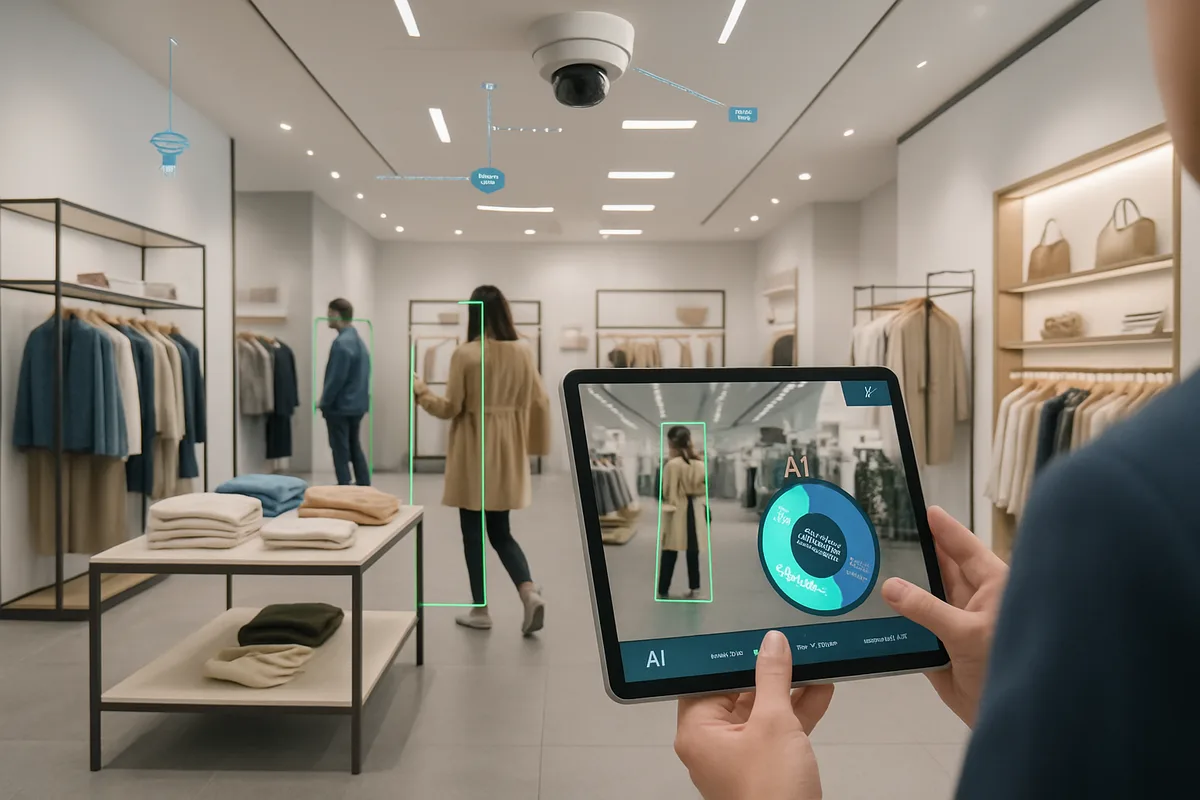
Modern computer vision processes anonymized video streams in real time. These systems map customer paths through a store the way Google Analytics maps clicks through a website. These aren't the grainy CCTV feeds from a decade ago.
Retailers using AI-driven foot traffic analytics report a 15% average sales increase. That's driven by better product placement and store flow adjustments. One European grocer used ceiling cameras and AI to discover that shoppers consistently skipped a back corner. Relocating a popular seasonal display to that neglected zone produced measurable traffic improvements — the kind of insight you'd never extract from a POS report alone.
Enterprise-scale deployments now operate in venues like Mall of America and across major coffee chains, using privacy-first re-identification technology. The term "re-identification" sounds paradoxical, but the technology tracks anonymous behavioral patterns — not faces. A shopper who visited the cosmetics department three times this week gets counted as a return visitor without ever being personally identified.
Fashion and beauty retailers gain particular value here. Your digital team can A/B test a banner ad in an afternoon. Now your store teams can measure whether moving a fixture 10 feet changed traffic flow within days.
Predictive Analytics Platforms for Customer Journey Intelligence
Counting visitors tells you what happened. Predictive analytics tells you what's about to happen — and that distinction changes how you spend your marketing budget.
AI-driven customer segmentation has moved far beyond age-and-gender demographic buckets. Modern algorithms analyze thousands of behavioral interactions simultaneously: dwell time in specific zones, repeat visit frequency, purchase timing patterns, responses to promotions. Retailers implementing these advanced segmentation techniques have achieved up to 30% improvement in marketing ROI compared to traditional methods.
Churn prediction is where this gets especially interesting for brand-affinity businesses. AI models can now identify which customer segments are drifting away before they've fully disengaged, reducing attrition by 20–25% in competitive markets. If you manage trade marketing for a fashion or beauty brand, that early warning system means you can intervene with a targeted in-store experience or personalized offer while the customer still cares.
Some platforms push real-time preference analysis directly to store associates. Rather than relying on a salesperson's intuition, the system surfaces data-backed recommendations: this customer segment responds to sustainability messaging, that one responds to exclusivity. The associate becomes an extension of your marketing strategy, not a separate channel entirely.
You can finally start answering questions like: did the endcap display drive the sale, or did the customer arrive already intending to buy? That's the attribution problem that's haunted physical retail marketing for decades.
Privacy-Compliant AI Customer Behavior Analysis Tools
If a platform can't clearly articulate its privacy architecture within the first five minutes of a demo, walk away. Privacy isn't a feature to evaluate — it's a requirement.
GDPR certification has become table stakes in European markets. This was accelerated by high-profile concerns — including ACLU reports documenting retailers using facial recognition for government coordination. Those cases have intensified regulatory scrutiny and made privacy architecture a procurement requirement rather than a marketing talking point.
The best AI tools for in-store customer behavior analysis now operate on anonymous tracking architectures by design. They never collect or store images, video, or personal data. Instead, they process behavioral signals — movement patterns, zone engagement, dwell duration — and discard the raw input immediately. The analytical depth doesn't suffer. You still get heat maps, journey data, and conversion metrics. You just don't carry the liability of a personal data store.
Balancing accuracy with compliance isn't the tradeoff it used to be. Five years ago, anonymization meant losing fidelity. Today's systems maintain 89% demand-prediction accuracy while operating within strict regulatory boundaries. The engineering has caught up with the legislation.
Retailers operating across multiple European markets face practical challenges. A platform certified under German privacy standards may not automatically satisfy French CNIL requirements. Your vendor's compliance architecture should be jurisdiction-aware, not just GDPR-stamped.
ROI Measurement and Implementation Success Factors
87% of AI projects never reach production. The technology works. The implementation often doesn't.
When it does work, the numbers are striking. McKinsey estimates hyper-personalization via behavior and transaction data can drive up to 40% revenue boosts. That figure isn't theoretical — it reflects retailers who've built the data pipelines, tested the algorithms, and validated outcomes against control groups.
Data quality is the prerequisite that kills most projects. As LVMH's Stanislas Vignon has emphasized, AI isn't a magic wand without the right data. If your POS system, loyalty app, and in-store sensors feed into separate silos with inconsistent formats, no AI platform will deliver measurable value. The data plumbing comes first.
Three implementation factors separate successful deployments from expensive experiments:
- Baseline measurement before deployment. You can't prove a 15% sales lift without knowing where you started. Establish traffic, dwell, and conversion baselines across test and control locations.
- Testing and validation protocols. Algorithmic shelf optimization and personalized content delivery need A/B testing adapted for physical retail — not just digital.
- Cross-functional ownership. The marketing team cares about campaign attribution. Operations cares about staffing efficiency. Finance cares about cost per acquisition. A successful implementation serves all three, which means all three need to shape the requirements.
Attribution remains unsolved, but the gap between "we have no idea what drove that sale" and "we can isolate the contribution of in-store signage with 80% confidence" represents billions in recovered marketing spend. That's the ROI case worth making to your CFO.
Selecting the Right AI Behavior Analysis Platform for Your Retail Strategy
Retail leaders anticipate a 52% jump in AI investments beyond traditional IT over the next year, with the majority flowing into CRM, personalization, and predictive analytics — not infrastructure. Global AI spending in retail is projected to exceed $2 trillion in 2026, growing 36.8% from 2025.
Your selection should account for three dimensions:
Scale fit. Enterprise platforms supporting 1,000+ brands across 25,000+ stores offer benchmarking advantages — your performance data gains context when compared against hundreds of similar locations. Specialized vertical solutions, on the other hand, may deliver deeper insight for specific formats like beauty retail or FMCG. Neither is universally better. Match the platform's scale to your operational reality.
Integration requirements. The best AI tools for in-store customer behavior analysis don't exist in isolation. They connect to your loyalty app data, Wi-Fi analytics, digital signage CMS, POS system, and CRM. Ask vendors specifically: how does your platform ingest data from our existing stack? If the answer involves "custom development" for basic integrations, expect timeline delays and hidden costs.
Outcome specificity. Avoid platforms that promise everything. You're solving specific problems: measuring the effectiveness of in-store campaigns, understanding the path to purchase, bridging the gap between your digital marketing data and your physical store data. The right platform should answer those questions within 90 days of deployment, not 18 months.
One final consideration: the market is moving toward agentic AI — systems that don't just report what happened but take autonomous action, like adjusting digital signage content based on real-time traffic patterns or triggering personalized offers when a high-value segment enters a zone. Nine in 10 retail executives expect AI to surpass search engines as a primary commerce channel by 2026. The platform you choose today should have a credible roadmap for that future, even if you're starting with foot traffic basics.
Sources
- IBM-NRF Consumer Study 2026 — 45% of consumers use AI during buying journeys, 72% still shop in stores
- McKinsey — The Future of AI-Powered Personalization — hyper-personalization revenue impact research
- NRF Retail AI Trends 2025 — 90% of retailers applying or evaluating AI, executive investment sentiment
- NRF Retail Trends in AI — AI adoption rates and consumer AI usage statistics
- PwC — Inside NRF 2025 — key takeaways on AI in retail from Retail's Big Show