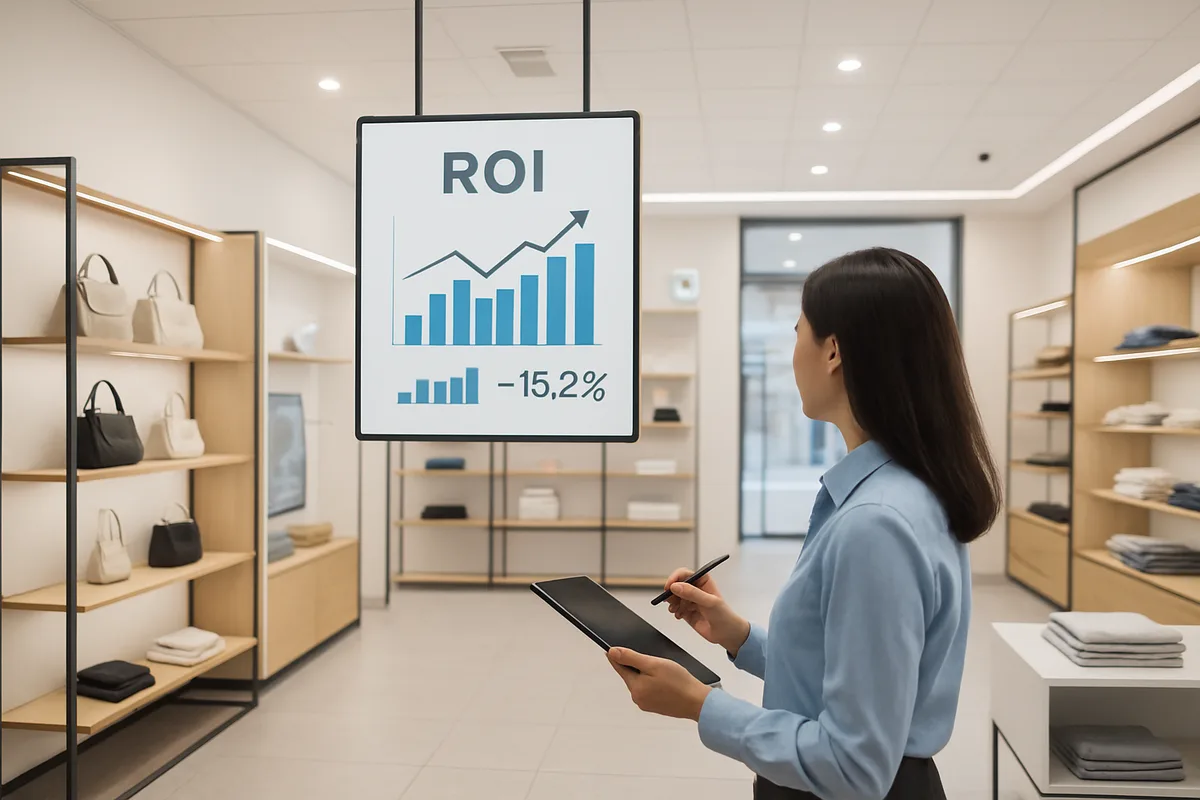
How to Calculate Digital Signage ROI Accurately: A Framework for Store Success
You designed a beautiful store concept with integrated screens, ambient lighting, and perfectly placed digital displays. The CFO asks one question: "What's the return?" Understanding how to calculate digital signage ROI accurately separates approved projects from spreadsheet casualties.
The formula looks simple:
ROI = (Total Benefits − Total Costs) / Total Costs × 100
What makes it hard isn't the math. It's knowing what to count—and what you're probably missing.
Benefits break into three categories:
- Direct sales impact — measurable revenue lifts from promotions displayed on screens
- Operational savings — reduced print costs, faster content updates, less manual merchandising labor
- Efficiency gains — improved staff allocation, fewer VM compliance errors, less time spent on campaign rollouts
Here's a real example. A European retailer deployed promotional screens at a total cost of €12,000 (hardware, software, content production, labor). The tracked benefits—sales uplift plus print substitution savings—hit €17,600. That's a 46.7% ROI, validated through POS-linked analytics. Not spectacular, but specific. Defensible. The kind of number that gets a second round of funding.
The trick isn't inflating projections. It's capturing benefits that are actually happening but going unmeasured.
Building Your Cost Foundation for Digital Signage ROI Calculations: The Hidden Expenses
Most ROI calculations fail not because revenue numbers are wrong, but because the cost side is incomplete. Count only hardware? You're building on sand.
Start with a full cost inventory across three layers:
Capital expenditure (Year 0)
- Display hardware — commercial-grade screens, mounts, media players
- Installation labor — cabling, structural modifications, integration with existing fixtures
- Initial content production — design, motion graphics, campaign assets
Depreciate hardware over 3–5 years. A $5,000 screen spread over five years costs $1,000 annually on your books—a very different number than the upfront hit.
Recurring operational costs
- Software subscriptions for content management — roughly $1,200/year per deployment
- Maintenance and repairs — budget around $500/year per location
- Energy consumption — commercial displays running 12+ hours daily add up
Hidden labor costs
This one gets overlooked constantly. Someone creates the content. Someone schedules it. Someone troubleshoots when a screen goes dark on a Saturday afternoon in your flagship store. Don't account for ongoing management hours? Your denominator is artificially low—and your ROI looks better than reality.
The retail example above broke down cleanly: $6,700 annual cost split between $5,000 hardware (depreciated), $1,200 software, $500 operations. Every dollar accounted for.
How to Calculate Digital Signage ROI Accurately Through Sales Attribution
Attribution is where most signage ROI projects stall. A screen shows a promotion. Sales go up. But did the screen cause it, or was it the weather, competitor stockout, or just Tuesday?
Three methods cut through the noise:
Zone-based analytics
Pair foot traffic sensors with POS data. Measure what happens in the physical zone around each display. Dwell time near a promotional screen increases by 40%? Sales of the featured product rise 15% in that zone while staying flat elsewhere? You've got a causal signal worth presenting.
A/B testing on parallel screens
Run two different content versions on screens in comparable store zones or locations. Keep everything else constant: same product, same price, same period. Compare conversion rates. One fashion retailer found motion-based content outperformed static imagery by 22% on average transaction value—a finding they wouldn't have without controlled testing.
POS integration for promotion tracking
This is the most direct line you can draw. Display a QR code or unique promotion on screen. Track how many people scan it and complete a purchase. The redemption rate becomes your attribution metric. No ambiguity. The screen drove that specific action, and the receipt proves it.
Without at least one of these methods, you're guessing. Guesses don't survive finance reviews.
Analytics Tools That Make Digital Signage ROI Visible
Raw data doesn't convince anyone. What convinces people is structured evidence organized around the questions they're already asking. Build your measurement stack in three tiers:
Tier 1: Operational metrics
Screen uptime percentage, playback accuracy, content schedule compliance. These don't directly prove revenue impact, but they establish that your network is actually running as designed.
Tier 2: Engagement metrics
Impressions (how many people passed the screen), dwell time (how long they stopped), interaction rates (touches, scans, QR engagements). These bridge the gap between "the screen exists" and "people responded to it."
Tier 3: Business impact metrics
Sales uplift, conversion rate changes, average basket size, promotion redemption rates. This is where your CFO lives. Everything else is context for these numbers.
AI-driven vision analytics are accelerating what's possible here. One documented retail deployment using camera-based audience measurement across hundreds of screens achieved up to 3.5x ROI improvement. How? By tailoring content to the demographic profile of people actually standing in front of each display.
Cross-channel tracking ties it together. A customer sees a promotion on an in-store screen, scans a QR code, and completes a purchase at checkout. That journey—from screen impression to transaction—becomes a trackable event. Show the CFO a dashboard with that funnel? The conversation changes from "does this work?" to "where should we put the next screen?"
Real-World ROI Examples: Learning from Successful Store Deployments
Theory is nice. Numbers from actual stores are better.
Example 1: Small-format retail — 124% ROI
A retailer invested $6,700 annually ($5,000 hardware depreciated, $1,200 software, $500 operations). Tracked sales attributed to screen-promoted products showed a $15,000 revenue increase. That's a 124% ROI—the investment paid for itself within 12 months and kept delivering.
Example 2: Vision analytics at scale — 3.5x ROI uplift
Large-format deployment using AI-powered audience analytics across hundreds of screens. They identified which content performed best with different customer segments. Rotating content based on real-time demographic signals—age, gender, attention patterns—select stores achieved up to 3.5x ROI compared to stores running static playlists.
Example 3: Print substitution as ROI multiplier
Don't ignore the cost you stop spending. Retailers replacing printed POS materials—posters, shelf talkers, promotional signage—with digital alternatives typically add 15–25% to their overall ROI calculation through print savings alone. One department store chain calculated €4,200 annually in eliminated print production and distribution costs across a single flagship.
The pattern across all three examples: specificity wins. Vague claims about "increased engagement" don't survive scrutiny. Dollar figures tied to tracked promotions do.
Common Pitfalls: How to Calculate Digital Signage ROI Accurately Despite Variables
Even good measurement frameworks break down if you ignore variables working against clean data.
Pitfall 1: No baseline
Don't measure sales, foot traffic, and dwell time before installing screens? You can't prove anything changed after. Capture at least 8–12 weeks of pre-deployment data. Match it to the same calendar period if possible—comparing January pre-install to July post-install is meaningless in fashion retail.
Pitfall 2: Ignoring seasonality
A screen installed in October will look like genius by December. Run sensitivity analyses: what does your ROI look like if the sales uplift is 10% instead of 20%? Present a range, not a single number.
Pitfall 3: Isolated metrics that don't connect
Knowing that 50,000 people walked past a screen last month tells you nothing about business impact. Knowing that 12% stopped, 3% scanned a QR code, and 1.8% completed a purchase—that's a story. Always connect screen-level data to store-level outcomes through POS or CRM integration.
Pitfall 4: Forgetting to re-measure
ROI isn't a one-time calculation. Content gets stale. Audience behavior shifts. Schedule quarterly reviews, swap underperforming content, and treat your screens like you'd treat a website: test, measure, iterate.
Sources
- Screenfluence — Digital signage ROI metrics evaluation and calculation examples
- Navori — How digital signage analytics improve ROI, including 3.5x case study
- Screenly — Digital signage ROI formulas and cost breakdowns
- YESCO — Measuring ROI of print and digital signage